Alexithymia Test for Adults: Practical Emotional Awareness Toolkit
Have you recently taken an alexithymia test? You've answered the questions, received your score, and now you’re facing a big question: what comes next? It's common to feel a sense of clarity mixed with uncertainty. Knowing you might have traits of alexithymia is a significant first step, but without direction, that knowledge can feel isolating. This is where practical, actionable steps make all the difference.
If you're looking for ways to better understand your emotional landscape, this toolkit is for you. It’s not about quick fixes but about gradual, meaningful progress. We've designed these exercises specifically for individuals who find it difficult to identify and describe their feelings. The journey to greater emotional awareness starts with small, consistent efforts.
This guide will walk you through foundational concepts, daily exercises, and visual tools to help you build a stronger connection with your inner world. For a personalized starting point, our online alexithymia test can provide valuable initial insights. Let’s explore the practical emotional awareness exercises you can start using today.

Building Your Emotional Foundation
Before diving into daily exercises, it's crucial to build a solid foundation. Understanding what you're working with is the key to effective change. This means looking at your unique emotional profile and learning the basic science of how emotional literacy develops in the brain. This initial step ensures your efforts are both informed and effective.
Understanding Your Alexithymia Profile
Your score on an alexithymia test is more than just a number; it's a starting point for self-discovery. It gives you a snapshot of your current patterns in identifying, describing, and processing emotions. Do you find it hard to distinguish between feeling anxious and excited? Do you tend to focus on the physical symptoms of an emotion (like a racing heart) without knowing what feeling is causing it?
Understanding your profile means recognizing these specific tendencies. Your main challenge might be finding the right words for your feelings. Alternatively, it could be connecting with your body's signals. By reflecting on your results from an assessment like the alexithymia questionnaire, you can tailor the following exercises to your specific needs, making your practice much more powerful.
The Science Behind Emotional Literacy Development
Developing emotional literacy is a skill, much like learning a new language. It involves creating and strengthening neural pathways in your brain. These pathways connect the regions that sense physical sensations with those responsible for higher-level thinking and language. For individuals with alexithymia, this connection can be weaker.
The good news is that our brains are incredibly adaptable—a concept known as neuroplasticity. The exercises in this toolkit are designed to repeatedly activate and reinforce these pathways. When you practice a body scan, you are intentionally linking a physical feeling to a potential emotion. When you journal, you are practicing the translation of internal states into words. Each small effort helps build a more robust emotional processing system over time.
Daily Exercises for Emotional Awareness
Consistency is the most important factor in developing new skills. Integrating short, simple exercises into your daily routine can create lasting change without feeling overwhelming. These practices are designed to be accessible and easily adapted to your life, helping you build emotional awareness brick by brick.
The Body Scan Method
The body scan is a foundational mindfulness practice that reconnects your mind to your body. Since people with alexithymia often experience emotions as unexplained physical sensations, this exercise helps you become a detective of your own bodily cues.
- Find a Quiet Space: Sit or lie down comfortably for 2-5 minutes. Close your eyes if you feel comfortable.
- Start with Your Feet: Bring your attention to the soles of your feet. Notice any sensations without judgment: warmth, coolness, tingling, pressure.
- Move Up Slowly: Gradually move your attention up through your body—your legs, your torso, your arms, your neck, and your head. Spend a few moments on each part, simply observing what is there.
- Notice Areas of Tension: Pay special attention to your stomach, chest, shoulders, and jaw, as these areas often hold emotional tension. Just notice it; you don't need to change it.
By doing this daily, you create a detailed internal map. Over time, you'll start to recognize patterns, like a tight chest appearing before a stressful meeting, which is a crucial first step toward identifying anxiety.
Micro-Emotion Journaling
Traditional journaling can be daunting if you don't know what you feel. Micro-emotion journaling breaks it down into manageable, objective observations. Instead of asking "How do I feel?", you ask "What did I notice?"
-
Set a Time: Dedicate 5 minutes at the end of each day.
-
Use Simple Prompts: Answer one or two of these questions:
- "What was one moment today where my body felt a strong sensation (e.g., tense shoulders, warm face, tight stomach)?"
- "When did I feel the most energy today? When did I feel the least?"
- "What was one thing someone said that made me pause?"
-
Don't Force Labels: Simply describe the event and the physical or mental reaction. For example: "During the team meeting, I noticed my jaw was clenched." That's it. This log becomes data you can look back on to see patterns.

Progressive Labeling Practice
Once you become more comfortable noticing sensations, you can begin to attach potential labels to them. This exercise is about experimenting with words, not getting them "right."
- Identify a Sensation: Using your body scan or journaling notes, pick one physical sensation you noticed. For example, a "fluttery feeling in your stomach."
- Brainstorm Broad Labels: Start with basic categories. Does this feel "good" or "bad"? "Active" or "calm"?
- Get More Specific: Use an emotion wheel (discussed next) or a simple list of emotions. Could that "fluttery" feeling be excitement? Nerves? Anticipation?
- Try On the Words: Say to yourself, "Maybe this is excitement." See how that feels. There's no pressure to be certain. The goal is to practice connecting sensations to a wider vocabulary of feeling words.
Visual Tools for Emotional Mapping
For many people, especially those who are neurodivergent or think visually, abstract concepts like emotions become clearer with visual aids. Emotion wheels and mapping techniques turn the internal, unseen world of feelings into something tangible you can see and interact with, making it less confusing.
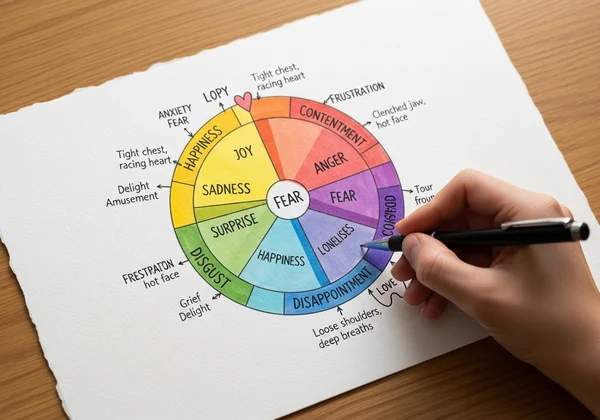
Creating Your Personal Emotion Wheel
A standard emotion wheel is a great tool, but creating your own makes it far more relevant. A personal wheel connects abstract emotion words to your concrete, lived experiences and physical sensations.
-
Start with Core Feelings: In the center of a piece of paper, write 4-6 basic emotions you are familiar with, like Happy, Sad, Angry, and Scared.
-
Branch Out: Draw lines out from each core feeling. On these lines, write more specific words. For example, from "Angry," you might branch out to "Irritated," "Frustrated," or "Resentful."
-
Add Physical Cues: This is the most important step. Next to each emotion word, write down the physical sensations you associate with it. "Irritated" might be linked to "tense shoulders." "Happy" might be "warmth in my chest."
-
Use It: When you notice a sensation during the day, look at your wheel. See if you can find a match. This tool acts as a personal dictionary, translating your body's language into emotional words.
Color-Coded Sensation Mapping
This exercise takes the body scan one step further by creating a visual record. It's particularly helpful for seeing how different situations impact you physically and emotionally over time.
- Get a Body Outline: Print a simple, blank outline of a human body. You can easily find these online.
- Assign Colors: Choose a few colors and assign them to broad categories of sensation. For example:
- Red: Tension, pain, heat
- Blue: Calm, coolness, relaxation
- Yellow: Energy, buzzing, tingling
- Gray: Numbness, emptiness
- Map Your Sensations: After a significant event or at the end of the day, take a colored pencil or marker and color in the parts of the body outline where you felt those sensations.
- Add Notes: In the margins, write a few words about what was happening when you felt that way (e.g., "After my phone call with my boss").
Over a few weeks, these maps will create a powerful visual diary, showing you clear patterns between life events and your physical-emotional responses. To understand your unique patterns better, you can always revisit the online alexithymia test and compare your insights.
Your Journey Toward Greater Emotional Connection
Living with alexithymia and building emotional awareness is like embarking on a personal journey of discovery. There's no quick fix—it's about progress, not perfection. The practical exercises in this toolkit—from body scans to personal emotion wheels—are designed to be your companions on this path. They provide a structured way to turn confusion into curiosity and disconnection into connection.
Here are the key insights to remember as you begin this journey:
- Start with your body: Your physical sensations are the most reliable clues to your emotional state.
- Be consistent: Small, daily practices build stronger neural pathways than infrequent, intense efforts.
- Stay curious, not critical: The goal is observation without judgment. Every insight, no matter how small, is progress.
This journey is unique to you. Understanding where you start is essential for choosing the right tools. Ready to better understand your emotional patterns? Your first step is simple and waiting for you.
Take our free alexithymia test today to receive your instant score and unlock the option for a detailed AI-powered report with actionable advice tailored just for you.

The Takeaway
How long does it take to see improvement in emotional awareness?
Progress varies greatly for each person. Some may notice small changes within a few weeks of consistent practice, like being able to identify strong emotions like anger or anxiety more reliably. Deeper, more nuanced emotional understanding can take several months or longer. The key is patience and consistency, not speed.
Can these exercises replace professional therapy for alexithymia?
No. These exercises are powerful self-help tools for building skills, but they are not a substitute for professional therapy. Alexithymia is often linked to other conditions like trauma, autism, or depression. A qualified therapist can provide a formal diagnosis, help you address underlying causes, and offer specialized therapeutic approaches like CBT or mindfulness-based therapies. These exercises can, however, be an excellent complement to professional treatment.
What if I can't identify any physical sensations when doing body scans?
This is a very common experience for those with high alexithymic traits. Don't be discouraged. If you notice "nothing," simply observe that feeling of numbness or blankness. That itself is a sensation. Start by noticing more obvious things, like the feeling of your clothes on your skin or the temperature of the air. Over time, as you continue to practice, your sensitivity to more subtle internal signals will likely increase. For more guidance, our personalized AI report offers insights based on your specific test results.