TAS-20 vs OAQG-2: Understanding the Science Behind the Alexithymia Test
Ever wonder what happens when you take an alexithymia test online? Each question you answer about your emotional experiences goes into a sophisticated psychological framework that analyzes your responses. It is not just a random set of questions; it is a calculated look into how your brain processes feelings.
How does a simple questionnaire reveal the complexities of your inner world? Understanding the science behind the TAS-20 and OAQG-2 scales can demystify this process. It helps you interpret your scores more meaningfully. It also explains why these tools have become the gold standard in alexithymia research. Whether you are a "Self-Explorer" looking for answers or a professional seeking reliable data, knowing the "why" behind the alexithymia test is the first step toward deeper self-awareness.
Let's explore the science that powers your alexithymia assessment and what it reveals about your emotional world. We will explore how researchers measure things that often feel unmeasurable—our emotions—and how you can use this data to make life richer and exploration easier.

The TAS-20 Scale: The Gold Standard in Alexithymia Test Assessment
When you search for information about emotional blindness, the term TAS-20 (Toronto Alexithymia Scale) is likely the first thing you will encounter. It is widely considered the most validated instrument in the field of psychology for measuring this trait.
Origins and Development of the Toronto Alexithymia Scale
The TAS-20 was developed in the early 1990s by researchers R. Michael Bagby, James D.A. Parker, and Graeme J. Taylor. Before this scale existed, measuring alexithymia was difficult and often inconsistent. The researchers wanted to create a tool that was both easy to administer and scientifically rigorous.
They refined an earlier version, known as the TAS-26. The new questions specifically targeted the core traits of alexithymia. This helped researchers avoid confusing the results with other conditions like depression or anxiety. Today, it has been translated into dozens of languages and used in thousands of clinical studies. If you begin your alexithymia assessment today, you are engaging with decades of academic history.
Breaking Down the Three Core Components of TAS-20
The TAS-20 does not just give you one flat score; it measures three distinct "factors" or components of the alexithymic trait:
- Difficulty Identifying Feelings (DIF): This measures how hard it is to distinguish between different emotions. It also looks at the difference between feelings and physical sensations like a racing heart.
- Difficulty Describing Feelings (DDF): This focuses on your ability to find words to express your internal states to other people.
- Externally-Oriented Thinking (EOT): This measures a tendency to focus on external events and practical details rather than internal emotional experiences.
By looking at these three areas, the scale provides a multidimensional view of your emotional life. You might find you are great at identifying feelings but struggle to put them into words, or vice-versa.

Interpreting Your TAS-20 Score: What the Numbers Mean
In the traditional TAS-20 scoring system, your total score can range from 20 to 100. Most researchers use specific "cut-off" points to help categorize the results:
- 61 and above: Indicates high alexithymia traits.
- 52 to 60: Indicates possible or moderate alexithymia traits.
- 51 and below: Indicates non-alexithymia (a typical range of emotional processing).
It is important to remember that these numbers represent a spectrum. A high score is not a "failure" or a medical diagnosis; it is simply a reflection of your current cognitive style. Using a free online tool allows you to see where you fall on this spectrum in a private and safe environment.
OAQG-2 Methodology: The Modern Approach to Assessing Alexithymia
While the TAS-20 is the veteran in the field, the OAQG-2 (Online Alexithymia Questionnaire - Revised) represents the modern evolution of emotional assessment. It was designed specifically to bridge the gap between academic research and the digital world.
From OA to OAQG-2: Evolution of Assessment Tools
The original Online Alexithymia Questionnaire (OA) was created to make screening more accessible to the general public. However, our understanding of neurodiversity grew. Specifically, researchers saw a stronger link between alexithymia and autism. The scale needed updating to reflect these changes.
The OAQG-2 emerged as a refined version. It incorporates better psychometric properties and more inclusive language. This evolution reflects a growing move toward "user-friendly" science that doesn't sacrifice accuracy.
The 20-Question Structure: How OAQG-2 Measures Emotional Processing
The OAQG-2 typically uses a 20-question format. This mirrors the efficiency of the TAS-20 but uses wording that is more relatable to modern users. It focuses heavily on the "functional" aspects of emotional processing.
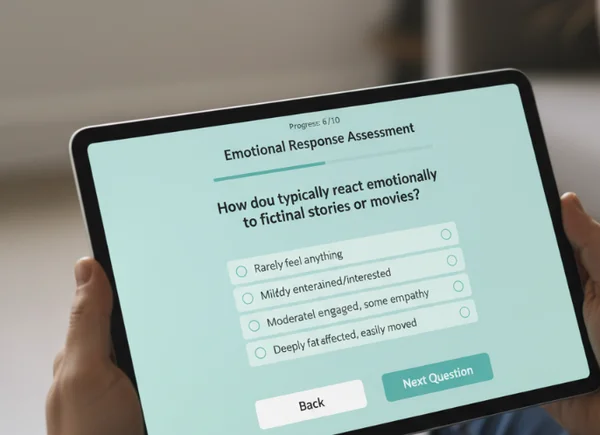
For example, instead of just asking if you are "confused" by feelings, the OAQG-2 methodology might look at how you react to emotional scenes in movies. It might also ask how you handle conflict in relationships. This structure ensures that the test captures the nuances of how alexithymia manifests in daily life.
Comparing OAQG-2 Results to Established Benchmarks
The OAQG-2 offers valuable context through benchmarking. When you get your results, your answers are compared against a large database of previous test-takers. This helps you see whether your experience is unique or shared by others. This comparative approach is part of why we encourage users to see your results through a lens of curiosity rather than judgment.
The Psychology of Self-Report Measures: Strengths and Limitations
Both the TAS-20 and OAQG-2 are "self-report" measures. This means the accuracy of the test depends on your own perception of your experiences. In the world of psychology, this approach has both incredible value and specific challenges.
Why Self-Report Measures Remain Valuable in Psychological Assessment
Self-reporting is the "gold standard" for internal experiences. No one knows your thoughts better than you do. For traits like alexithymia, the core issue is an internal lack of emotional awareness. Therefore, your subjective perspective is the most important data point. Self-report tests are:
- Private: They allow you to be honest without the fear of social judgment.
- Efficient: They provide a quick "snapshot" of your mental state.
- Empowering: They put the power of discovery in your hands.
Recognizing the Limitations: When Self-Reports Fall Short
There is a unique irony in alexithymia testing. If someone truly cannot identify their feelings, how can they accurately report on them? This is known as the "Alexithymia Paradox."
Some individuals might under-report their symptoms because they don't realize what they are missing. Others might over-report if they are currently going through a stressful period, which is called secondary alexithymia. Because of these limitations, our tool is for information and self-exploration, not a clinical diagnosis.
How Our Test Combines Multiple Approaches for More Accurate Results
To solve the limitations of traditional testing, our platform at AlexithymiaTest.com uses a dual-track system. We take the established scientific logic of the OAQG-2 and TAS-20 and combine it with modern technology.
Our AI personalized report dives deeper into the "why" behind your answers. It analyzes response patterns and consistency, offering insights that go far beyond what a simple number could provide. This approach provides a much more nuanced view of your emotional processing.
Beyond the Score: What Your Results Reveal About Your Emotional World
Getting a score is just the beginning. The real value of an alexithymia test lies in the insights you gain. You can learn more about your relationships, your communication style, and your mental health.
Patterns in Response: What Your Answers Say About Emotional Awareness
If you look closely at your results, you might see patterns. Perhaps you score high on "Difficulty Describing Feelings" but low on "Externally-Oriented Thinking." This suggests that you know you are feeling something, but you lack the vocabulary to share it. Understanding these patterns allows you to target specific areas for growth. You might try building an "emotion wheel" or practicing mindfulness to improve.
From Data to Insights: The AI Analysis Process
Data by itself is cold. That is why our advanced analysis option converts your raw questionnaire answers into a narrative. Our AI system looks at the intersection of your scores and the anonymous situational info you provide. It generates an AI personalized report that includes:
- Personal Strengths: How your logical, external focus can be an asset.
- Daily Challenges: Why certain social situations might feel draining.
- Action Plans: Concrete steps to improve emotional communication.
How Your Results Compare to Research Findings on Alexithymia
Finally, the science allows us to connect your experience to the broader human experience. Research shows that alexithymia is often highly correlated with the Autism Spectrum (ASD), ADHD, and past trauma. By understanding where you stand, you can better navigate these other areas of your life. You aren't "broken"; you simply have a different cognitive style that science is finally starting to understand.
Making Science Work for You: Applying Your Test Insights
What makes these assessment tools truly valuable is how they translate complex psychological concepts into practical insights you can apply to daily life. The TAS-20 and OAQG-2 are not just academic exercises. They are maps to help you navigate your own mind. By understanding the components of these scales—Difficulty Identifying Feelings, Difficulty Describing Feelings, and Externally-Oriented Thinking—you can move from confusion to clarity.
Your alexithymia assessment score isn't a final verdict—it's a map pointing toward areas where you can develop greater emotional awareness. Whether your result is high, moderate, or low, the goal is to use that information to live a richer life. If you are ready to take that first step, we invite you to start your test today. Discover your patterns, unlock deeper insights with our AI, and begin the journey of making exploration easier.
Frequently Asked Questions About Alexithymia Assessment Science
How accurate are online alexithymia tests compared to clinical assessments?
Online tests based on the TAS-20 or OAQG-2 are highly reliable as screening tools. They use the same logic as the forms you might fill out in a doctor's office. However, a clinical assessment involves an interview with a professional who can observe body language and social cues. Our online alexithymia test is an excellent first step for self-discovery, but it should not replace a professional diagnosis if you are seeking medical treatment.
Can TAS-20 and OAQG-2 results change over time?
Yes! Alexithymia is often considered a "state" as well as a "trait." While some people have a lifelong predisposition, others may develop these traits due to stress or trauma. As you go through therapy or practice emotional regulation, your ability to identify feelings can improve. This often leads to a lower score on future tests.
What makes these scales scientifically validated for alexithymia assessment?
A scale is "validated" when multiple peer-reviewed studies show that it consistently measures what it claims to measure. Both the TAS-20 and OAQG-2 have undergone "factor analysis" to prove their internal consistency. This means people who answer "yes" to one question about emotional confusion tend to answer similarly to related questions. This proves the test is measuring a real, identifiable trait.
How does the test account for cultural differences in emotional expression?
This is a vital area of modern research. Some cultures prioritize emotional restraint more than others. The OAQG-2 methodology attempts to use more neutral language to account for these differences. When you use our AI personalized report, the system can better interpret your results within a broader context. This makes the insights more relevant to your specific life experience.