Three Alexithymia Dimensions in Daily Life
A screening score can feel very heavy when it shows up all at once. Many people look at the total number and jump to one question: “So what does this say about me?” A more useful follow-up is: “Which part of emotional awareness felt hardest here?”
That is where dimension-level thinking helps. The online alexithymia screening is built to give a structured starting point, not a final label. Looking at the pattern behind the score can make the result easier to understand. It can also make the result easier to discuss with a qualified professional if needed.
Disclaimer: The information and assessments provided are for educational purposes only and should not replace professional medical advice, diagnosis, or treatment.

Why a Total Score Does Not Tell the Whole Story
A total score can show that emotional awareness may deserve a closer look. It does not show why one person struggled with the items or which part of the pattern stood out most.
Two people can land in a similar score range for different reasons. One person may notice strong body reactions but struggle to name the feeling behind them. Another may know something is happening internally but find it difficult to put that experience into words. A third may stay focused on facts, tasks, or external events and spend very little time reflecting on inner states.
That is why the three TAS-20 dimensions matter. They do not diagnose anything on their own, but they can help a reader ask better follow-up questions about what shows up in daily life.
What the TAS-20 Dimensions Are Measuring
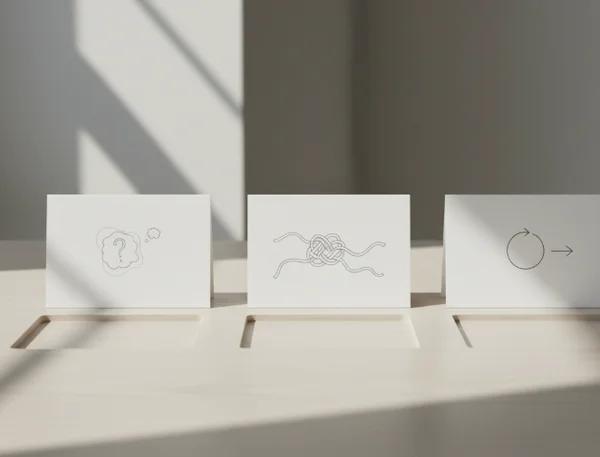
The three dimensions give the score structure. Instead of treating alexithymia as one flat trait, they separate different kinds of difficulty that can overlap but are not identical.
Difficulty identifying feelings is not the same as having no emotions
The original 1994 TAS-20 paper describes the measure as a 20-item scale. It reports good internal consistency, test-retest reliability, and a three-factor structure that fits the alexithymia construct. One of those factors is difficulty identifying feelings.
In daily life, that can look like knowing something is off without being able to tell whether it is sadness, anger, shame, stress, or emotional overload. The inner signal is present, but the label stays blurry. That is different from having no emotions at all.
This distinction matters because people with higher scores in this area may still react strongly. They may just notice the reaction later, misread it, or experience it as physical tension before they experience it as a named feeling.
Difficulty describing feelings and externally oriented thinking work differently
A 1996 PubMed paper states that the TAS-20 measures three intercorrelated dimensions. These are difficulty identifying feelings, difficulty describing feelings, and externally oriented thinking. Those last two dimensions often get blended together, but they are not the same.
Difficulty describing feelings is mainly about translation. A person may know they feel bad, hurt, tense, or disconnected, yet still struggle to explain the experience in a way that other people can understand. That can make support conversations feel frustrating on both sides.
Externally oriented thinking is different. It points to a style of paying attention that stays on facts, routines, tasks, and concrete events rather than inner reflection. Someone with higher scores here may answer “What happened?” easily, while finding “What did you feel?” much harder or less natural.
How These Dimensions Can Show Up in Ordinary Situations
A screening result becomes more useful when it is linked to ordinary situations. The goal is not to diagnose yourself from a few examples. The goal is to notice whether certain patterns feel familiar enough to explore further.
Conversations, conflict, and stress can expose different patterns
Daily interaction often shows the difference between the dimensions. In a tense conversation, someone with difficulty identifying feelings may suddenly shut down or become reactive without knowing what the emotion is. Someone with difficulty describing feelings may say “I don't know” over and over even when they clearly seem upset. Someone with a more externally oriented thinking style may keep returning to facts, schedules, or practical details while skipping the emotional layer of the exchange.
A 2023 PubMed study found positive links between TAS-20 subscales and interpersonal problems in healthy young individuals. The links were especially clear for difficulties identifying feelings and difficulties verbalizing feelings. That does not mean every relationship problem points to alexithymia. It does suggest that emotion labeling and emotion communication can matter a lot in ordinary social functioning.
Stress can make these patterns easier to notice. People often need more emotional clarity, not less, when they are overwhelmed. If the inner state becomes harder to identify or explain under pressure, that can be useful information to bring into reflection or professional support.
A high score in one area does not explain everything about a person
No single dimension tells the whole story about personality, coping style, culture, neurodivergence, trauma history, or relationship habits. A screening result is only one piece of a much larger picture.
That is why it helps to look for patterns instead of permanent conclusions. Maybe one dimension feels familiar and the others do not. Maybe the pattern only becomes obvious during conflict, fatigue, or sensory overload. Maybe the result overlaps with something you have already noticed in therapy or in your relationships.
The safest interpretation is usually the most useful one: this result may be pointing toward a real difficulty in emotional awareness, but it is not the same as a clinical diagnosis.
How to Use This Insight After a Screening Result
Understanding the dimensions is most helpful when it changes what you do next. The next step is usually not to force a label. It is to notice patterns more clearly and decide whether more support would help.

Reflect on patterns before jumping to labels
Start small. After a stressful interaction, ask what happened in the body, what thoughts showed up, and whether any feeling words fit even roughly. Notice whether the hard part is identifying the feeling, describing it, or slowing down enough to look inward at all.
The emotion awareness test can be more useful when it is paired with this kind of reflection. A score pattern becomes easier to understand when it is connected to moments from everyday life instead of treated as an abstract result.
Short notes can help here. You do not need a full journal. A few lines about conflict, avoidance, numbness, bodily tension, or delayed emotional reactions can create a clearer picture over time.
Bring the result to a qualified professional when needed
If these patterns cause persistent distress, repeated communication problems, or confusion about your inner state, it may help to discuss them with a doctor, therapist, or other qualified mental health professional. A screening result can be a useful conversation starter, especially when paired with a few real examples.
Professional support matters even more if emotional numbness, relationship strain, trauma-related symptoms, anxiety, depression, or self-harm concerns are also present. If distress becomes severe, if daily functioning keeps getting harder, or if you have any immediate safety concerns, seek professional help or emergency support right away.
The TAS-20 screening tool is most helpful when it is used the way the site intends: as a self-awareness resource and a possible starting point for a deeper conversation, not as a final answer by itself.
Next Steps After Understanding Your Score Pattern
A total score can point you toward the topic. The three dimensions can show you where the difficulty may be happening: naming feelings, putting them into words, or turning attention inward in the first place.
That kind of understanding does not solve everything, but it can reduce confusion. It can also make the next conversation with a trusted professional more specific and more productive.
When a screening result is used with curiosity, boundaries, and support, it can become a clearer starting point instead of a fixed label.