Why Can't I Express My Feelings: Understanding the Silence
You know the feeling. A lump forms in your throat. Your chest tightens. You want to speak, but your mind goes blank. Whether you are standing in front of a partner asking "what's wrong?" or sitting in a therapist's office, the result is the same: silence.
It is frustrating, isolating, and often exhausting. You might ask yourself, "Why can't I express my feelings like everyone else?" You may even worry that you are broken or emotionally cold.
But you are not broken. In fact, this struggle is more common than you realize. It often stems from a specific personality trait that creates a disconnect between your physical sensations and your ability to put them into words.
This guide will help you understand the root causes of your silence. We will explore the signs, the science behind the struggle, and actionable steps to help you find your voice.

What Is It Called When You Can’t Express Your Feelings?
When you consistently struggle to identify and describe your emotions, it is often referred to as alexithymia. This term comes from Greek roots meaning "no words for emotions."
It is important to understand that alexithymia is not a disease. It is a personality trait or construct. People exist on a spectrum. Some find it very easy to pinpoint exactly how they feel, while others find it nearly impossible.
Defining the Term: What Does "Alexithymia" Mean?
If you have high levels of alexithymia, you likely feel emotions physically but cannot label them mentally. For example, you might feel a racing heart and a stomachache, but you do not register the thought, "I am anxious." Instead, you just feel physically unwell.
Trait vs. Disorder: Understanding the Distinction
A common question is, "Is alexithymia a mental illness?" The short answer is no. It is considered a trait.
However, it often co-occurs with other conditions. You might see it alongside:
- Depression
- Anxiety
- Post-Traumatic Stress Disorder (PTSD)
- Autism Spectrum Disorder (ASD)
Understanding this distinction is crucial. It means you don't need to be "cured." Instead, you can learn skills to manage the trait and improve your emotional awareness. You can explore your current standing by taking an alexithymia test online to see where you fall on the spectrum.
Why It's More Common Than You Think
Roughly 10% of the general population experiences some form of alexithymia. In men, the numbers can be slightly higher due to social conditioning that discourages emotional vulnerability. You are certainly not alone in this experience.
Recognizing the Signs: The Disconnect Between Body and Mind
How do you know if you are dealing with alexithymia or if you are just stressed? The key lies in the disconnect between your body and your mind.
If you often wonder, "Why can't I express my feelings even when I want to?", look for these common patterns.
The "Words vs. Tears" Phenomenon: Why Do I Cry Instead of Speaking?
A very common symptom is the "cry response." You might find yourself crying uncontrollably during a conflict, yet you have no idea why.
This happens because the emotion has nowhere to go. Since you cannot process the feeling verbally ("I am sad because..."), the energy bypasses the language center of your brain and discharges physically through tears. It is your body’s way of releasing pressure when words fail.
Physical Signals: When Feelings Manifest as Headaches
For many people with emotional blindness, feelings present as somatic (physical) symptoms.
- Anger might feel like a hot face or clenched jaw.
- Anxiety might feel like nausea or a racing heart.
- Sadness might feel like a heavy weight in the chest or fatigue.
If you frequently visit doctors for stomach issues, headaches, or fatigue that have no medical cause, you might be experiencing unprocessed emotions.
Comparison: Internal Sensation vs. External Expression
To visualize this disconnect, compare how a neurotypical person processes emotion versus someone with alexithymia traits.
| Scenario | Typical Processing | Alexithymia Processing |
|---|---|---|
| Trigger | Boss criticizes work. | Boss criticizes work. |
| Internal Feeling | "I feel defensive and hurt." | "My stomach hurts. I feel tense." |
| Expression | Vents to a friend: "I'm so annoyed!" | Goes silent. Acts irritable but doesn't know why. |
| Result | Emotion is processed and fades. | Stress lingers physically; confusion remains. |
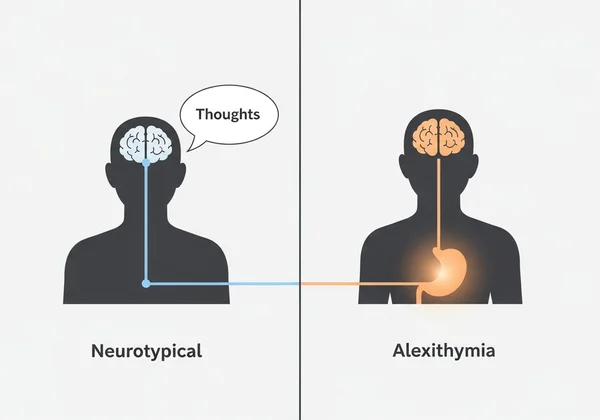
If this table feels familiar, it validates your experience. You are feeling something, but the bridge to expression is blocked.
The Relationship Barrier: Why Intimacy Triggers Silence
The struggle to express feelings is often most painful in romantic relationships. You might search Google for "why can't I express my feelings to my boyfriend" or partner, feeling guilty for your silence.
Scenario Reflection: The "How Was Your Day?" Freeze
Imagine your partner asks, "How are you feeling?" or "How was your day?"
For most, this is a simple question. For you, it might trigger a freeze response. You scan your brain for an answer, but find nothing. You might say "I'm fine" or "I don't know," not because you are hiding something, but because you genuinely do not know.
This silence can be deafening. It creates a wall between you and your partner, even though you crave connection.

Misunderstandings: When Silence Is Mistaken for Indifference
The tragedy of this trait is that partners often misinterpret the silence. They might think:
- You don't care.
- You are hiding a secret.
- You are emotionally cold.
In reality, you care deeply. You are likely overwhelmed by the sensory input of the emotion, but you lack the vocabulary to bridge the gap.
Uncovering the Roots: Why Is Emotional Expression So Hard?
So, where does this come from? Why can't I express my feelings while others seem to do it effortlessly? The causes are usually a mix of nature (genetics) and nurture (environment).
Nature: The Potential Link to Neurodivergence (ASD)
There is a strong overlap between alexithymia and neurodivergence, particularly autism. Some research suggests that up to 50% of autistic individuals also identify with alexithymia traits.
If your brain is wired to process details and logic over abstract emotional concepts, expressing feelings verbally will naturally be harder.
Nurture: Childhood Upbringing and Emotional Safety
Your environment plays a massive role. Ask yourself:
- Was I allowed to cry as a child?
- Did my parents talk about their feelings?
- Was I punished for being angry or sad?
If you grew up in a home where emotions were ignored or punished, you likely learned to suppress them to stay safe. Over time, this suppression becomes automatic. You stop noticing the feelings altogether.
Defense Mechanisms: Is It Trauma or a Trait?
Sometimes, emotional numbness is a defense mechanism. If you experienced trauma, your brain might have "turned off" the emotional valve to protect you from overwhelming pain.
This is known as secondary alexithymia. It is a survival strategy. While it protected you in the past, it now prevents you from fully connecting with yourself and others.
Mapping Your Emotional Landscape: A Step Toward Understanding
Understanding that this is a trait—not a personal failure—is the first step toward change. You cannot fix what you do not understand.
Why Self-Awareness Is the First Step
Before you can explain your feelings to a partner, you must be able to explain them to yourself. You need a baseline. You need to know if your difficulty is severe or mild, and which specific areas (identifying vs. describing) are most challenging.
Try the Assessment: Organize Your Thoughts (Not a Diagnosis)
If you are tired of the confusion, it can be helpful to see your traits laid out objectively. We offer a resource designed to help you explore your emotional processing style.
This is not a medical diagnosis. Instead, think of it as a tool to organize your thoughts. It helps you put data behind your feelings. By answering structured questions, you can begin to see patterns in how you react to the world.
You can try the alexithymia assessment to get a personalized report. This report can serve as a roadmap, giving you the language you need to explain your experience to loved ones or a therapist.
How a Personalized Report Helps You Communicate
Imagine handing a report to your partner that says, "I struggle to distinguish between anxiety and hunger" or "I process emotions physically before mentally."
Suddenly, it's not "you being difficult." It's a documented trait. This shifts the conversation from blame to understanding.
Breaking the Silence: Practical Ways to Start Expressing Yourself
Once you understand the "why," you can work on the "how." Learning to express emotions is like learning a new language. You have to start with the basics.
Bypassing the Speech Block: Start with Writing
If speaking feels impossible, don't speak. Write.
The part of the brain responsible for speech is often disconnected from the emotional center during stress. However, the motor function of writing can sometimes bypass this block.
- Action: Keep a notes app open. When you feel "off," just write down the physical sensations. "Chest tight. Hands shaking."
- Result: You are training your brain to observe the feeling without the pressure of conversation.
Using an "Emotion Wheel" to Find the Right Words
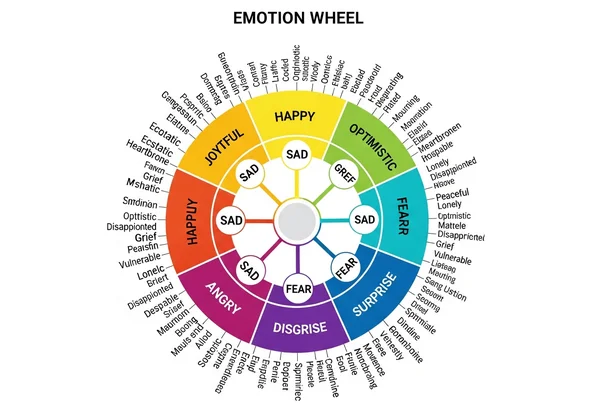
You cannot express what you cannot name. An Emotion Wheel is a visual tool that breaks down basic emotions (Happy, Sad, Angry) into specific nuances (Lonely, Frustrated, Grateful).
- Action: Save an image of an emotion wheel to your phone.
- Practice: Once a day, look at it and pick one word that matches your current state.
The "I Feel" Statement Practice
Communication requires structure. When you try to speak, use a simple formula to lower the cognitive load.
The Formula: "I feel [Physical Sensation], which makes me think I might be [Emotion]."
- Example: "I feel a knot in my stomach, which makes me think I might be anxious."
This takes the pressure off being 100% accurate. You are just reporting data.
You Are Not Broken, Just Unspoken
Asking "why can't I express my feelings" is a brave question. It means you are ready to bridge the gap between your internal world and the people around you.
Remember, alexithymia is a trait, not a life sentence. You are not broken; you just speak a different emotional language. With patience, self-reflection, and the right tools, you can learn to translate that silence into connection.
If you want to start that journey today, consider exploring your alexithymia traits online. It is a safe, private way to begin understanding yourself better.
Frequently Asked Questions
Can stress make it harder to express feelings temporarily?
Yes. Acute stress can cause "state alexithymia." When you are overwhelmed, your brain prioritizes survival over emotional expression. Once the stress reduces, your ability to express feelings often returns.
Is difficulty expressing emotions permanent?
Not necessarily. While alexithymia is a stable personality trait, emotional intelligence skills can be learned. With practice (and sometimes therapy), you can improve your ability to identify and describe feelings, even if it never feels completely automatic.
How do I explain this difficulty to my partner?
Be honest. Tell them, "I have a hard time putting feelings into words. It’s not that I don't care; my brain just goes blank." Sharing an article like this or your test results can also help them understand it is a real psychological concept.
Is this the same as suppressing emotions?
No. Suppression is a conscious choice (hiding what you feel). Alexithymia is a lack of awareness (not knowing what you feel). However, people who suppress emotions for years can eventually develop alexithymia traits.
At what point should I see a therapist?
If your inability to express feelings is causing depression, ruining relationships, or manifesting as chronic physical illness, it is time to seek professional help. A therapist can provide a safe space to practice these skills.